How to Choose the Right Plastic Wear Plates?
Choosing the right Plastic Wear Plates begins with understanding what they will face in service. A conveyor guide handling dry cartons has different needs from a slide plate exposed to grit, moisture, or cleaning chemicals. The wrong material may wear quickly, deform under load, or create more friction than expected. Small details matter.
Compare operating temperature, pressure, sliding speed, impact, and the type of mating surface. UHMW-PE is often considered for impact resistance and low-friction movement, while nylon may suit applications needing strength and stiffness. Neither is automatically the better choice. Actual performance depends on grade, design, and working conditions. Check the manufacturer’s technical data, including temperature limits, load guidance, and chemical compatibility. A sample test under realistic conditions can reveal issues that a specification sheet cannot.
Installation deserves equal attention. Measure the plate thickness and mounting points, then allow for expansion where temperature changes are likely. Poor alignment can cause uneven wear, even with a suitable polymer. That is easy to miss. Consider how the plate will be inspected and replaced, too; a difficult-to-access component can increase maintenance time. There may not be one perfect option, and I would be cautious about choosing by price or material name alone. Record the actual operating conditions and review them with a qualified supplier or engineer. That makes the final selection more reliable—and easier to revisit when conditions change.
Understand the Function and Working Environment of Wear Plates
How to Choose the Right Plastic Wear Plates?
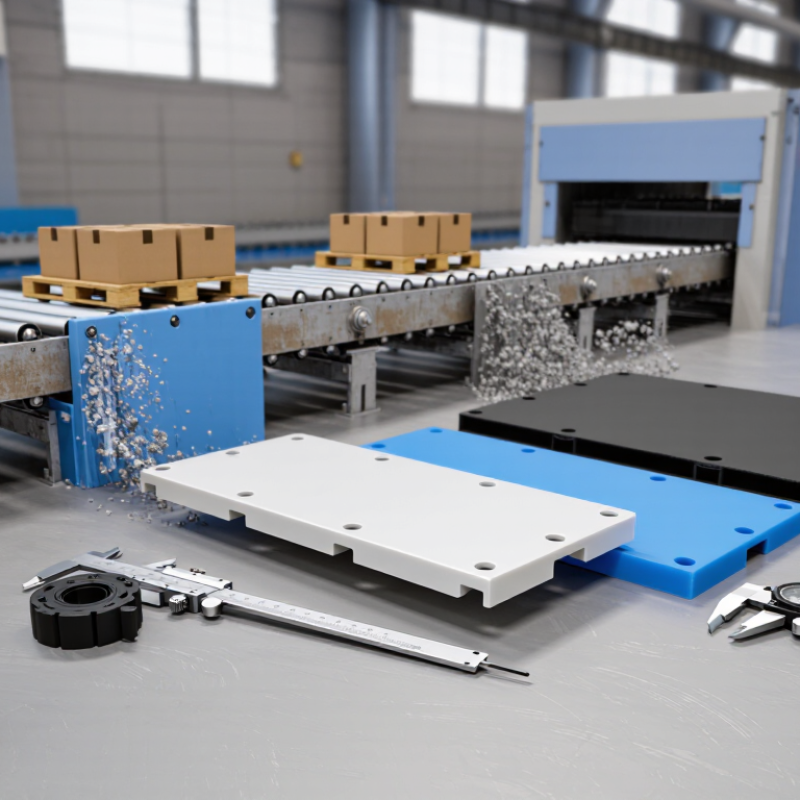
A wear plate protects the structure beneath it while reducing friction, noise, and material buildup. Start with the actual contact: Is the plate sliding against metal, carrying abrasive grit, or struck by falling parts? Note the load, speed, temperature, moisture, and cleaning chemicals. A chute carrying dry pellets has different demands from a damp conveyor handling mineral fines. Dust matters. So do sharp edges and start-stop cycles, which can cause wear that a steady-load test may miss.
Material data helps, but it needs context. ASTM D4020 specifies a minimum nominal molecular mass of 3.1 million g/mol for UHMW-PE resin, a useful material-identification benchmark—not a guarantee of service life. ASTM G99 describes a pin-on-disk method for comparing friction and wear under controlled conditions. Those results can guide screening, but actual plate life depends on the contact pressure, counterface, and contaminants in your equipment. Ask for test conditions, not just a wear-rate number. A small mismatch matters.
Tips: Map the wear zone and measure its temperature during a normal shift. Compare candidate plates under similar load, speed, and surface conditions. Check fastening, clearance, and replacement access, too. The best material can still fail early. Sometimes the test setup is the weak link.
Assess Load, Speed, Temperature, and Exposure Conditions
How to Choose the Right Plastic Wear Plates?
Assess load, speed, temperature, and exposure conditions together. A plate carrying a steady load may wear differently from one hit by repeated impacts. Note the real contact area, not just the machine’s rated capacity. Also record sliding speed and operating temperature during a full production cycle. Small details matter. ASTM G99-23 pin-on-disk testing measures friction and wear under specified test conditions, including load and sliding motion. Its results are useful for comparison, but they do not perfectly reproduce every conveyor, guide rail, or dusty workshop.
Temperature can change stiffness and wear behavior, while oil, cleaning chemicals, moisture, and abrasive grit may alter performance. Check the material’s published service limits against the hottest and coldest points your equipment actually reaches. For a wet line, ask for water-absorption data; ASTM D570 provides a standardized method for measuring it. Request test results that state temperature, load, speed, and test duration. Without those details, a quoted wear figure can be hard to apply. I would be cautious about choosing from a single “wear resistance” number; it may hide the conditions that matter most. A short trial using the actual counterface and lubricant can expose a poor fit before plates are installed across the line.
Compare Plastic Materials and Their Wear Properties
How to Choose the Right Plastic Wear Plates?
Compare Plastic Materials and Their Wear Properties
Wear performance depends on load, speed, temperature, surface finish, and lubrication—not just the plastic type. ASM Handbook, Volume 18, gives indicative dry-sliding friction ranges against steel: PTFE is about 0.05–0.10, UHMW-PE 0.10–0.20, and acetal roughly 0.20–0.35. Treat these as guides, not guarantees; test conditions can change the results. UHMW-PE suits abrasive chutes and conveyor guides, while acetal offers better dimensional stability for accurately fitted parts. Nylon handles higher mechanical loads, but absorbed moisture can change its dimensions. PTFE slides easily, yet may deform under sustained pressure.
Test the real contact pair. ASTM G99-23 describes a pin-on-disk method, but a laboratory result may not match a dusty conveyor or a hot, wet production line. Record load, sliding speed, temperature, and wear depth, then compare candidate plates under the same conditions. Small details matter.
Tips: Check the mating surface and expected impact, not only friction data. A plate that slides well can still wear quickly under grit or edge loading. And the “best” material may be a compromise. That is worth checking twice.
How to Choose the Right Plastic Wear Plates?
Typical dry-sliding coefficient of friction ranges against steel
Lower friction can help reduce drag, but it does not by itself mean better wear resistance. Values are indicative ranges, not guaranteed specifications; results vary with grade, counterface, load, speed, temperature, and lubrication. Compare wear-test data under your actual operating conditions before selecting a plate.
Determine Plate Dimensions, Thickness, and Mounting Requirements
Choosing a plastic wear plate starts with the contact area, not the catalog size.
Measure the working surface and note the direction of movement. Include edge clearance, bolt locations, and space for thermal expansion. A plate that fits when cold may bind as machinery warms. Check the full travel path, especially near joints and corners.
Measure twice.
Thickness depends on support and load, not just expected wear.
A thicker plate can resist bending, but it may raise the moving part or reduce clearance. Consider impact, continuous pressure, sliding speed, and whether the backing surface is flat. Uneven support can make a thin plate flex and wear unevenly. Compare measurements with the equipment drawing, then verify them on the machine before cutting.
Small misalignments matter.
Tips:
Confirm hole spacing and fastener access before ordering. Choose mounting holes or slots that allow practical installation and any needed adjustment. Keep fasteners flush where sliding contact could catch them. If loads or operating temperatures vary, check the material data and test a sample under real conditions. I have found that drawings can miss worn or slightly warped surfaces, so inspect the actual mounting area too.