Top 10 Flange Source Factories for Global Buyers
Choosing a Flange Source Factory is not just a price comparison. For global buyers, the real test is whether a supplier can deliver consistent dimensions, traceable materials, and dependable lead times. A flange may look perfect in a catalog. The details matter.
W. Edwards Deming, a pioneer in quality management, is widely associated with the principle, “Quality is everyone’s responsibility.” That idea fits flange sourcing: quality depends on material checks, machining controls, inspection records, and clear communication—not a final certificate alone. Buyers should ask how factories verify pressure ratings, surface finish, and dimensional tolerances. They should also check whether sample parts match production batches. A polished brochure cannot answer those questions.
This guide introduces ten flange source factories for global buyers and the practical signals worth comparing. It considers product range, manufacturing capability, quality documentation, export experience, and responsiveness. These factors help narrow the field, but they do not replace direct verification. A factory’s strengths can vary by product and order size. Even a promising supplier may need closer review. That is an imperfect truth of sourcing, and it deserves attention.
What Flanges Are and How They Are Used
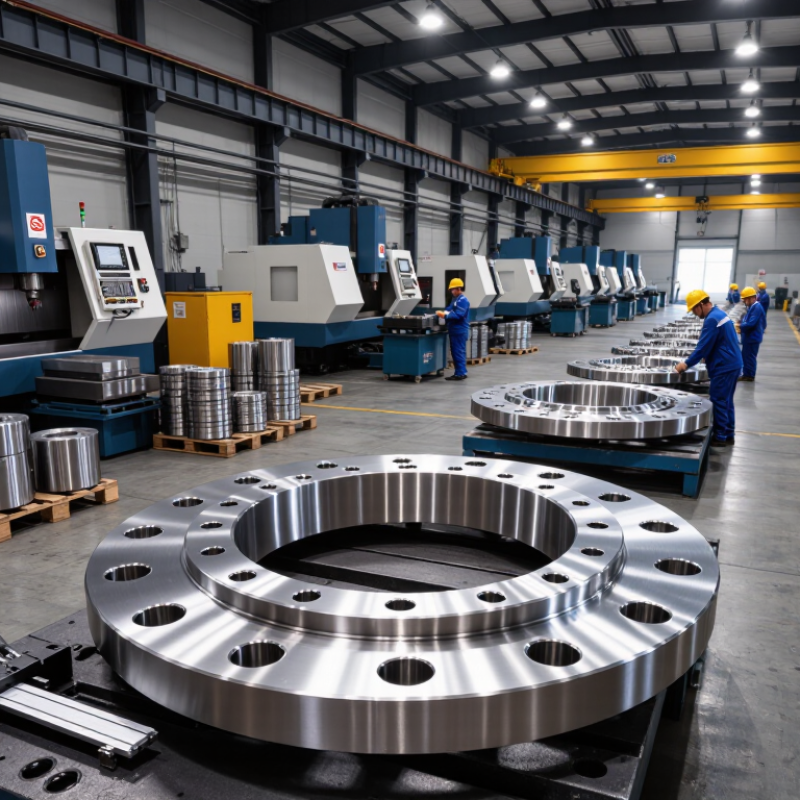
A flange is a raised or flat rim that connects a pipe to another pipe, a valve, pump, or vessel. Bolts clamp the joint together, while a gasket helps seal the space between mating faces. Some flanges are welded to the pipe; others use threads or slide over the pipe before welding. Blind flanges close an unused line. Simple idea. The details matter.
In a piping system, flanges make inspection and maintenance easier because workers can open a joint without cutting the pipe. They also help connect equipment with different functions. A gasket may be soft or metallic, depending on service conditions and the flange faces. Pressure, temperature, fluid, material, and bolt requirements all affect the choice. A familiar size alone is not enough.
A flange can look correct on a drawing and still cause trouble if the faces are misaligned or bolts are tightened unevenly. That is easy to overlook. Buyers should check dimensions, material records, facing, and applicable project specifications with qualified technical staff. No single flange suits every service, and supplier documentation should be reviewed rather than assumed complete. Even careful checks have limits.
How to Assess Flange Factories for Global Sourcing
Top 10 Flange Source Factories for Global Buyers
How to Assess Flange Factories for Global Sourcing
Assess a flange factory through evidence, not polished presentations. Check whether its product range matches your drawings, including pressure class, facing, dimensions, and material grade. Ask how staff verify chemical composition and mechanical properties. Reliable suppliers can explain their inspection steps and provide traceable test records for specific batches. Details matter.
Review production capacity against your order size and delivery schedule. A factory may quote a short lead time, but ask which stages happen in-house and which are outsourced. Request recent sample reports, packaging photos, and references from buyers with similar requirements. If possible, inspect the workshop or arrange an independent quality assessment. One visit helps, but it cannot prove every batch will be consistent. Keep that in mind.
Tips: Send a clear drawing and written specification. Compare quotations line by line, including inspection, packing, and delivery terms. Test a sample before placing a large order. Record unanswered questions, too; vague replies can reveal gaps worth discussing.
Profiles of Ten Flange Source Factories
Profiles of Ten Flange Source Factories
These ten profiles describe factory capabilities, not an audited ranking of named suppliers. One factory focuses on forged carbon-steel rings; another works mainly with stainless grades. A third produces large-diameter weld-neck flanges, while a fourth handles blind and slip-on designs. A fifth accepts custom dimensions. That matters. World Steel Association’s World Steel in Figures 2025 reports 1,882.6 million tonnes of crude steel production in 2024, but high output alone says little about a flange maker’s process control.
The remaining profiles highlight machining accuracy, documented heat treatment, small-batch flexibility, export inspection records, and integrated forging with machining. Buyers can compare each capability against drawings, material certificates, and inspection plans. Ask how a factory checks bore dimensions, flange-face finish, and bolt-hole alignment; request sample records, not just catalog claims. A polished website is not proof. Even a capable supplier may have uneven documentation, and that deserves a closer look.
Use recognized specifications, such as ASME B16.5 where applicable, to define dimensions and pressure classes. Confirm the stated material grade and testing scope before placing an order. The World Steel Association figure provides supply-chain context, not evidence of any individual factory’s quality. That distinction is easy to miss.
Comparing Product Range, Quality, and Export Capabilities
When comparing ten flange source factories, start with product range, not catalogue length. A capable supplier should clearly list material grades, sizes, pressure classes, facing types, and applicable standards. Carbon steel and stainless steel suit different service conditions; alloy grades may be needed for heat or corrosion resistance. Request dimensional inspection records, material test certificates, and heat-number traceability. Small gaps matter. A broad catalogue can still omit uncommon dimensions or custom machining. The World Steel Association’s World Steel in Figures 2024 reports 1,892.2 million tonnes of crude steel production in 2023. This shows the scale of the upstream market, not the quality of any individual flange.
Quality claims deserve evidence. Compare inspection procedures, test documentation, and the factory’s ability to keep specifications consistent across repeat orders. Export readiness matters too: confirm lead times, protective packaging, document preparation, and experience shipping to your destination. UNCTAD’s Review of Maritime Transport 2024 reports that global maritime trade grew 2.4% in 2023. That figure offers context, but it cannot guarantee a smooth delivery. Ask for realistic shipping schedules and clear answers about delays. A low quotation may look attractive, yet unclear tolerances or incomplete records can create costly uncertainty. One detail is easy to overlook: verify that sample documentation matches the production order.
Top 10 Flange Source Factories for Global Buyers — Comparing Product Range, Quality, and Export Capabilities
A practical sourcing benchmark: the chart compares pressure-rating designation counts in widely used flange standards. It does not rank factories or represent company-specific product, quality, or export data.
Counts shown: ASME B16.5 — 7 classes; ASME B16.47 — 6 classes; EN 1092-1 — 12 PN designations; JIS B 2220 — 7 pressure designations. Applicable ratings vary by size, material, and standard requirements. Verify current editions and factory documentation when assessing suppliers.
How to Verify and Select the Right Factory
Selecting a flange factory requires evidence beyond a polished catalogue. Global steel supply is vast: the World Steel Association reported 1,882.6 million tonnes of crude steel production in 2024. Yet that figure says nothing about one supplier’s material control. Check whether the factory actually forges and machines flanges, or outsources critical steps. Ask for a live production walkthrough. Small details matter.
The ISO Survey 2023 recorded 1,265,216 valid ISO 9001 certificates worldwide. Certification can indicate a quality-management system, but it does not prove that a particular flange meets its drawing or pressure rating. Request heat-specific material test certificates, dimensional inspection reports, and traceability linking each flange to its heat number. Match bore, outside diameter, thickness, facing, and bolt-hole spacing against the approved drawing and applicable standard. For a first order, inspect a sample or arrange an independent pre-shipment check. I would also verify audit scope and recent corrective-action records; a certificate alone is thin evidence. Factory selection can be imperfect, especially when records look complete but production details remain unclear.